November 8, 2026 | Korean Culture · United Kingdom
London is hosting two major Korean cultural festivals this autumn, bringing a wider range of Korean music and cinema to audiences across the city. The K-Music Festival offers everything from traditional instruments and experimental rock to jazz, while the London Korean Film Festival presents new releases, independent films and discussions with filmmakers. They are separate events, but together they demonstrate how Korean culture in the UK extends far beyond K-pop.
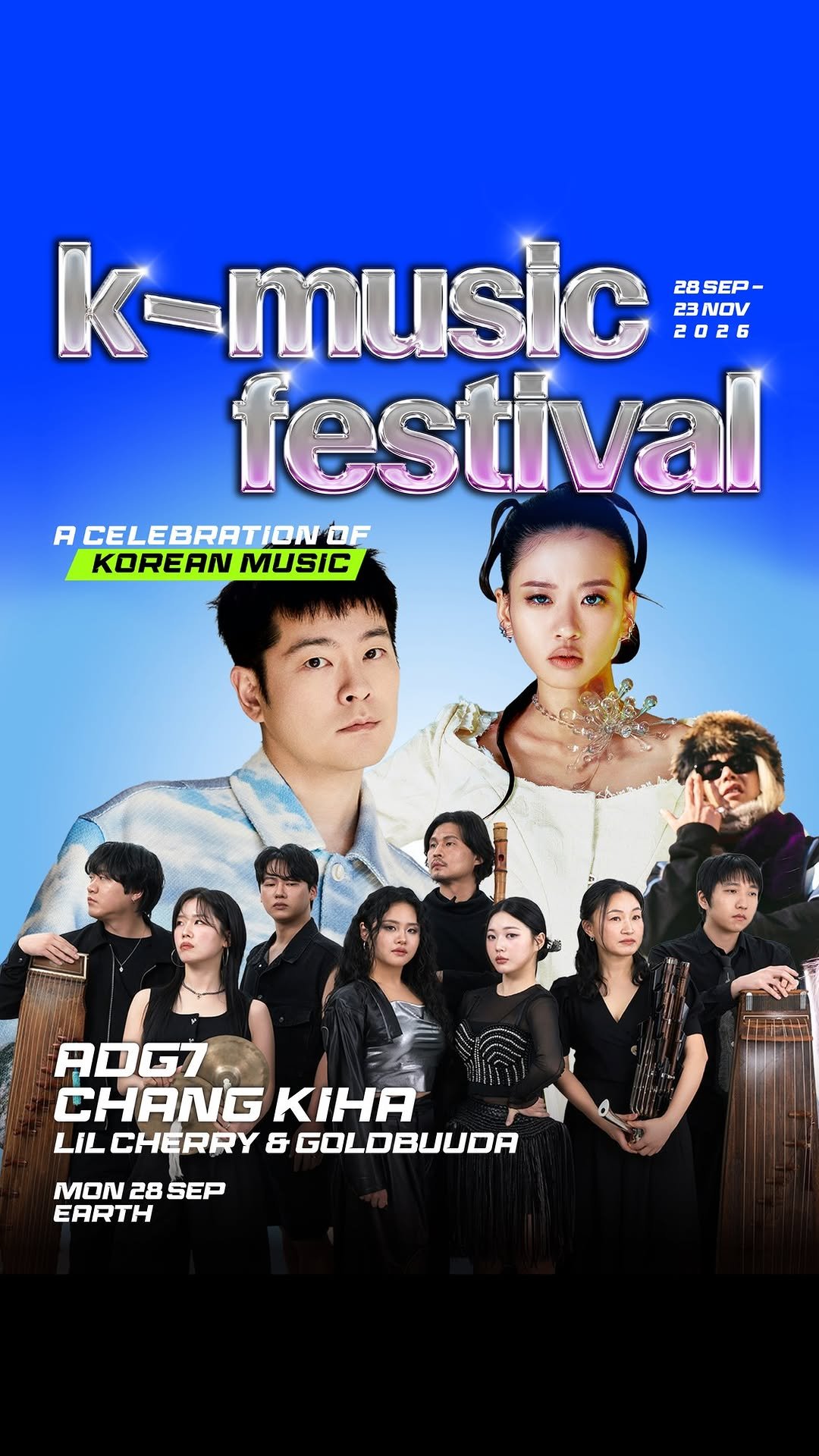
K-Music Festival celebrates Korean sounds beyond K-pop
Now in its 13th edition, the K-Music Festival runs from September 28 to November 23, 2026, with performances at London venues including Southbank Centre, Royal Albert Hall, Rich Mix and EartH Theatre. The programme moves between Korean folk traditions, experimental sound art, indie rock, hip-hop, video-game soundtracks and jazz. Rather than treating those styles as separate worlds, it puts the connections between them on stage.
The opening night brought together ADG7, singer-songwriter Chang Kiha and hip-hop duo Lil Cherry & GOLDBUUDA. Elsewhere in the programme, Chudahye Chagis brought ritual-music influences into contemporary funk and R&B, while gayageum musician Kyungso Park collaborated with Swedish bassist Björn Meyer. Such pairings show how musicians can take familiar Korean sounds into unexpected settings.
There are still performances to come in November. Dongyang Gozupa plays Rich Mix on November 11, combining Korean musical textures with a powerful post-rock approach. On November 23, pianist Jisu Jung and Baroque in Blue close the festival at Upstairs at Ronnie’s with music that brings jazz improvisation into conversation with Baroque composition. Both concerts offer something different from a conventional pop showcase.
One of the festival’s strengths is that it does not force traditional music and contemporary experimentation into opposing categories. Artists can draw on rhythmic patterns, instruments or performance practices rooted in Korean traditions while still making something unmistakably new. For listeners who associate Korean music almost exclusively with polished idol productions, that creative range may be the biggest discovery of the festival.
London Korean Film Festival continues through November 16
Running from November 2 to 16, the 21st London Korean Film Festival is taking place at BFI Southbank, Ciné Lumière and the Institute of Contemporary Arts (ICA). Organised by the Korean Cultural Centre UK and supported by the Korean Film Council, it offers a selection of recent Korean films, independent voices and special screenings. The programme gives filmgoers a chance to explore storytelling that might not otherwise reach their local cinemas.
The festival opened on November 2 with Kim Mi-jo’s The Journey to Gyeong-ju, accompanied by a discussion with invited guests. Other notable selections include Lee Chang-dong’s Possible Love and the festival’s Women’s Voices programme, which highlights emerging independent female filmmakers. The mix of established names and smaller productions helps present a more varied picture of Korean cinema.
The remaining schedule includes Mongrels on November 12 and Once We Were Us on November 13 at BFI Southbank. On November 14, ICA hosts the Women’s Voices short-film programme. Park Hoon-jung’s Tristes Tropiques is the closing gala film on November 16, with a director Q&A announced. Screening details and ticket availability should be checked with the organisers.
A film festival can encourage a similar sense of discovery. Viewers might arrive to see a director they already admire, then stay for an independent feature or a short film they would never have encountered through mainstream streaming recommendations. Introductions and filmmaker conversations can make those encounters more rewarding, allowing audiences to understand how individual works fit into Korea’s changing film landscape.
Two festivals, one wider view of Korean creativity
These events are not a joint festival. Their dates simply overlap, and each has its own lineup and programme. What connects them is the opportunity they give London audiences to discover aspects of Korean culture beyond the most internationally familiar artists and entertainment formats.
Someone who first became interested in Korea through K-pop might discover a traditional instrument, a boundary-crossing jazz group or a filmmaker telling an intimate story. A regular filmgoer might find that the country’s contemporary music scene is just as adventurous. That exchange of interests is part of what makes London’s autumn Korean cultural calendar worth following.
Both festivals are listed by the Korean Cultural Centre UK. Visitors can find updates through the K-Music Festival programme and the London Korean Film Festival schedule.
London Korean festivals 2026: dates and highlights
| Event | 2026 dates | What to expect |
|---|---|---|
| K-Music Festival | September 28–November 23 | Traditional Korean sounds, experimental music, indie and jazz |
| London Korean Film Festival | November 2–16 | Contemporary Korean cinema, independent film and filmmaker conversations |
For anyone making plans, the first step is to choose a particular concert or screening rather than assume the festivals share one venue. The K-Music programme moves between London stages, while the film screenings take place across several cinemas. Check each official event page for the specific time, location and ticket status before travelling.
Explore more stories about Korean music and film through the K-POP Insights archive, or browse the K-POP Calendar for other upcoming events. These festivals are a reminder that a growing interest in Korean pop culture can open the door to unfamiliar sounds, stories and artists.
Sources
Korean Cultural Centre UK — K-Music Festival 2026 · London Korean Film Festival — Official 2026 Programme.