HYBE’s strategic partnership with Creative Artists Agency (CAA), announced in the United States on November 16, 2026, and in South Korea on November 17, is about more than putting K-pop artists in front of a larger audience. The two companies intend to develop creative and commercial opportunities around HYBE’s artists and intellectual property (IP), spanning entertainment, brands, licensing, sports and live experiences.
For HYBE, the agreement raises a bigger question: how can a music company build a lasting business around its artists without relying on the next album or world tour alone? CAA offers an extensive network across the global entertainment industry, while HYBE brings artists, music, stories and highly engaged fan communities. The value of the partnership will depend on what they can build together, not simply on the scale of their combined networks.
What HYBE and CAA have actually agreed
Executives discussed the collaboration at the HYBE Global Leadership Summit on November 13. HYBE chairman Bang Si-hyuk and CAA chief executive and co-chairman Bryan Lourd also discussed the relationship between artists and the companies that support them. The subsequent announcement identifies Korea, Japan, the Americas, China and India as markets for potential joint initiatives.
The agreement establishes a framework for working together. The announcement does not disclose a financial value, a timetable for individual projects, an equity transaction or a blanket representation agreement for all HYBE artists. It would therefore be premature to describe this as an acquisition or assume that any specific group has signed a new exclusive CAA contract.
What does CAA bring to a K-pop company?

Creative Artists Agency was established in Los Angeles in 1975 and operates across film, television, music, sports and other entertainment businesses. Its existing work with Korean talent is particularly relevant: CAA already has a Seoul presence and industry relationships that extend well beyond music.
A company such as HYBE can develop and manage its own artists and content, but a global project often requires additional partners: broadcasters, producers, distributors, sponsors, sports organizations and local event operators. CAA could help HYBE connect its artists and intellectual property with the right global business partners. Access to that network is not the same as guaranteed distribution or revenue, however.
Five business areas worth watching
| Announced area | Possible application |
|---|---|
| Content | Concert films, documentaries or original screen projects |
| Live experiences | New event formats and fan experiences in additional markets |
| Brand partnerships | Campaigns with international fashion, lifestyle or consumer brands |
| Sports | Collaborations involving sports events, organizations or audiences |
| Licensing and merchandise | Authorized products and experiences based on artist or content IP |
For fans, these collaborations could offer new ways to connect with their favorite artists between album releases. For HYBE, they could mean additional opportunities to earn from an existing catalog or creative concept. The challenge is to build something fans genuinely want, rather than treating every new format as another product to sell.
The financial context: higher revenue does not guarantee higher profits
HYBE’s expansion predates this partnership. Its annual financial results show how rapidly the business has grown and why managing the costs of expansion matters.
| Financial year | Consolidated revenue (KRW trillion) | Operating profit (KRW billion) |
|---|---|---|
| 2021 | 1.256 | 190.3 |
| 2022 | 1.776 | 236.9 |
| 2023 | 2.178 | 295.6 |
| 2024 | 2.256 | 184.0 |
| 2025 | 2.650 | 49.3 |
Annual revenue more than doubled between 2021 and 2025, but operating profit fell substantially from its 2023 peak. The latest quarterly performance shows another side of the business: HYBE’s November 3 preliminary release put third-quarter 2026 revenue at approximately KRW 1.53 trillion, up 109.8% year on year, with KRW 188.5 billion in operating profit. BTS’s world tour was a major driver of the quarter, according to reporting on those results.
These are historical results, not earnings generated by the CAA partnership. They help explain the strategic opportunity: new revenue streams could make the business less sensitive to individual release and touring cycles. Whether they improve profitability will depend on production expenses, partner fees, contractual terms and the actual demand for the projects.
Why local markets matter as much as global distribution

HYBE is not starting from zero outside Korea. Its existing label network and international projects already reach different languages, markets and musical traditions. KATSEYE, developed through HYBE and Geffen Records, is one example of a globally oriented act created through a separate partnership. KATSEYE illustrates HYBE’s international strategy, but no new CAA project involving the group has been announced.
The five regions identified in the CAA agreement offer different opportunities. Japan has established music and fan-merchandise markets. The Americas offer access to entertainment and brand networks. China and India present distinct audiences, distribution systems and local business conditions. The success of any initiative will depend on local partners, suitable formats and relevant permissions rather than simply copying the same campaign everywhere.
The fan relationship is an asset that cannot be taken for granted
Artist IP can include protected recordings, visual material, fictional characters and other creative assets. But an artist’s name, image and likeness may involve different rights and contractual permissions. A company-level partnership does not automatically confer every right needed for a new project. Artist participation, consent, credits, compensation and creative control remain important.
There is also a practical limit to diversification. Fans have finite time and money. A new film or well-designed experience can make a group’s creative work more accessible, while excessive merchandise or poorly matched endorsements can weaken trust. Successful collaborations should enrich the fan experience rather than simply create more opportunities to sell products.
What would make the partnership a success?
- Specific projects: Look for joint announcements identifying the artists, format, territory and release or event schedule.
- New audiences: Assess whether collaborations reach people beyond established fandoms while remaining relevant to existing supporters.
- Financial quality: Watch whether new businesses contribute meaningful earnings after costs, rather than judging success by revenue alone.
- Artist participation: Look for clear creative roles, appropriate credit and projects that fit the artists’ identities.
The significance of the HYBE–CAA partnership is not that K-pop has suddenly become global. Its international audience is already well established. The partnership will test whether K-pop’s global popularity can translate into a broader, more sustainable entertainment business. If the companies combine their strengths effectively, they could open new creative and commercial avenues for K-pop. For now, the agreement represents an opportunity; its impact will become clearer as specific projects are announced.
Related KWaveScope reading
- BIGHIT MUSIC: BTS, TXT, CORTIS and HYBE
- HYBE CINE FEST: how K-pop concerts reach cinema audiences
- SM Entertainment’s 2027 growth strategy
Sources
- Pollstar, November 16, 2026 — partnership announcement and business scope.
- NewsPim, November 17, 2026 — HYBE leadership summit and Korean announcement.
- HYBE investor-relations income statement — 2021–2025 consolidated financial figures.
- Yonhap News Agency, November 3, 2026 — preliminary Q3 earnings.
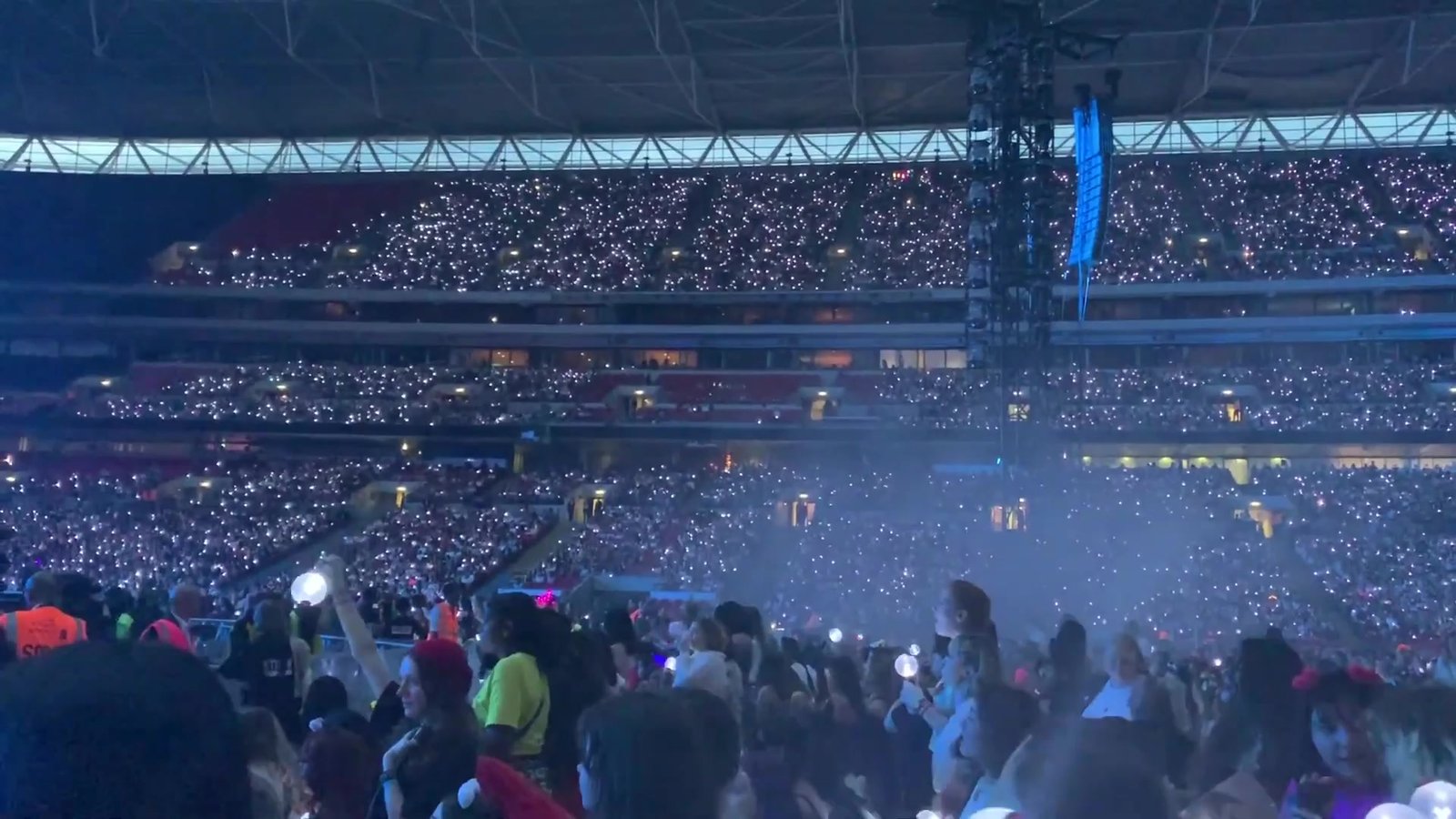
Image licenses: BTS audience photo (CC BY 3.0); CAA building photo (CC BY-SA 3.0); KATSEYE photo (CC BY 4.0). Images are archival, not photographs of the November 2026 partnership announcement. The CAA image has been resized.