KWaveScope Insight | October 23, 2026
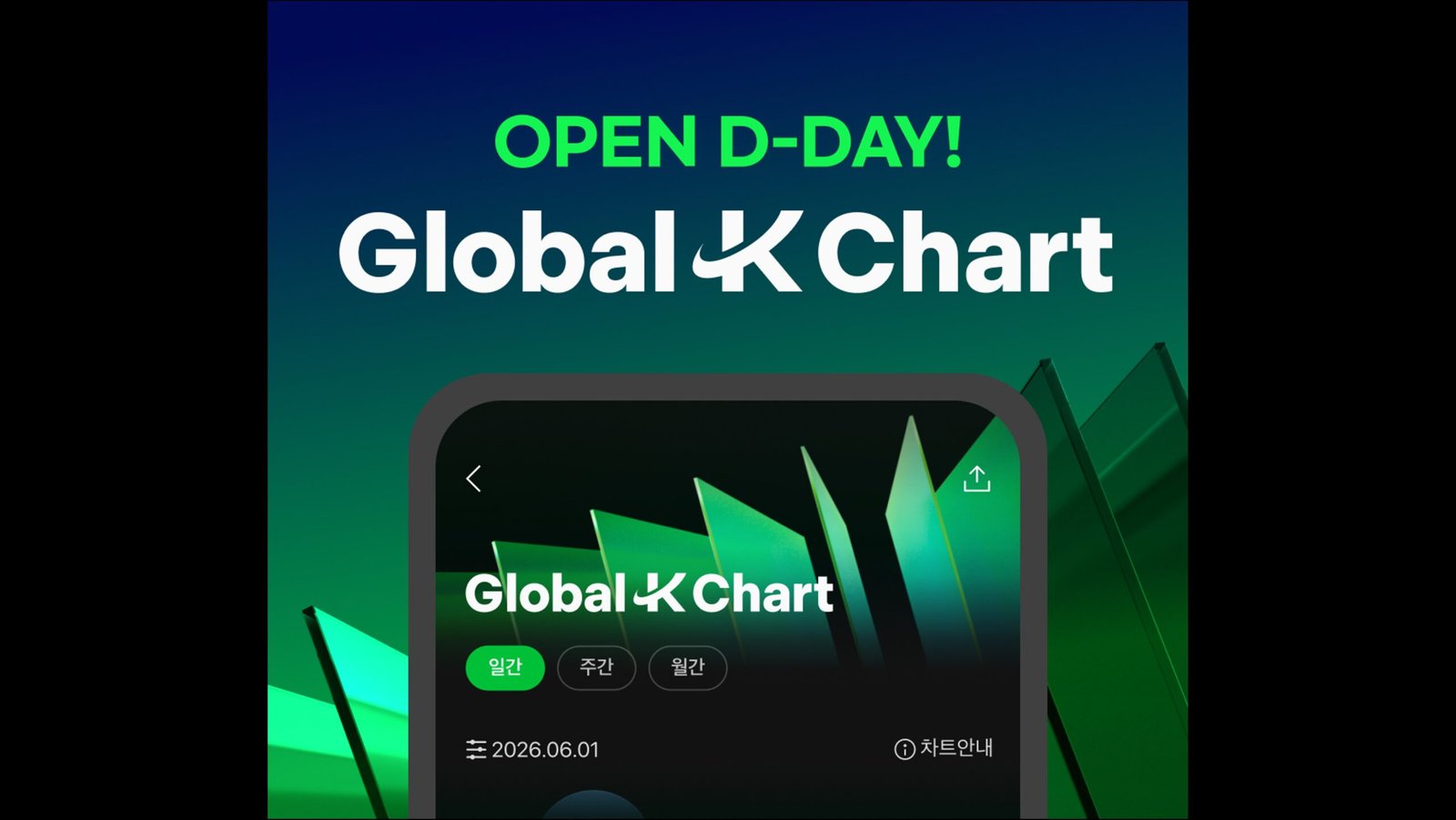
When a Korean music service says most of its audience is now overseas, the natural question is whether K-pop has outgrown the borders of the platform that helped build it. Melon’s latest figures make that question hard to ignore. Kakao Entertainment announced on October 22 that the Global-K Chart reached 3,011,516 monthly active users in September. Of those, 2,564,133 accessed the service from outside South Korea — about 85 percent of the total.
It is a striking reversal of the conventional picture of Melon as primarily a domestic music service. But the more interesting development isn’t simply the size of the audience. Melon is trying to turn a music chart into a shared space for international fandom, combining data, artist interviews and low-friction participation. The reported growth suggests that strategy is drawing attention. Whether that attention becomes lasting loyalty is the next test.
The numbers behind Melon’s international surge
The Global-K Chart launched in June 2026 in collaboration with Tencent Music in China and LINE MUSIC in Japan. Four months later, Kakao Entertainment released figures that show how quickly people have begun visiting the service.
| Measure | Reported figure | Why it matters |
|---|---|---|
| September Global-K Chart monthly active users | 3,011,516 | More than three million people used the chart during the month, according to Melon. |
| Growth from June | 45.5% | Melon reported about 2.069 million monthly users in the launch month. |
| September overseas monthly active users | 2,564,133 | Approximately 85% of the September audience accessed from outside Korea. |
| Growth in overseas monthly users from June | 152% | The overseas audience grew much faster than the overall audience. |
| Cheering actions in 20 days | Approximately 1.08 billion | This measures repeated fan actions, not distinct people. |
The comparison is significant because it is not merely a bigger total. In June, Melon reported 1,017,573 overseas users. By September, that figure had risen to more than 2.56 million. The change in the audience mix points to interest from people who may not previously have had much reason to visit a Korean music portal.
That does not mean 2.56 million people abroad took out paid Melon subscriptions. Monthly active users are not the same as paying customers. Nor does the figure prove that every one of those users listens to full tracks through Melon. It describes the chart’s audience as reported by the company, not subscription revenue or worldwide K-pop consumption.
Why a music chart needs more than rankings
For years, music charts did an apparently simple job: they told listeners which tracks were popular. That still matters, but it is no longer the only reason fans open a music app or website. International K-pop fandom also wants to know where an artist is gaining momentum, how supporters in different places are responding and whether the community’s enthusiasm has any visible effect.
Global-K Chart was built around this wider definition of engagement. Its underlying rankings use streaming and fan-activity indicators from participating Korean, Chinese and Japanese music services. That is different from simply asking overseas fans to vote in a popularity contest. The chart’s promise is that actual listening and other platform signals can be brought into a common view, even though the contributing services operate in distinct markets.
There is a methodological distinction worth keeping in mind. The three-country data partnership describes where the chart’s participating music-service indicators originate. The 85 percent overseas MAU figure describes where visitors to Melon’s chart service were accessing it from. Those are related but not identical measurements. Fans accessing the site from Brazil or the United States do not automatically make American or Brazilian streams part of the three-platform chart calculation.
This distinction makes the business strategy more interesting rather than less. Melon can build a worldwide audience for information and participation around data supplied by a smaller number of established music markets. A chart becomes both a measurement product and a destination.
The 1.08 billion cheering figure needs careful reading
Nothing in the October announcement is more eye-catching than the cheer count. Melon said the Global-K Chart’s ‘Cheer’ feature attracted approximately 1.08 billion cheering actions over 20 days. The feature allows fans to express support through the chart website, without a separate login requirement.
The size of the number is impressive as an engagement measure, but it is easy to misunderstand. One billion cheering actions does not mean one billion fans. The same person may participate repeatedly. The total should not be treated as a headcount, a stream count, a vote by one billion distinct users or a monetary result. It tells us that the participation system is designed to generate frequent interactions, and fans are using it at very large scale.
Melon also said overseas participants represented more than half of the people taking part in the feature during its first week. That detail may be more useful than the headline total. It indicates that users outside Korea were not only reading the rankings; at least some were actively using a fan-facing function built for the chart.
Why would that matter commercially? Repeated visits give a platform more chances to become a habit. Fans may return to check a favorite artist’s position, take part in a daily activity or share a result with friends. None of those behaviors guarantees subscription income, but they create a reason to keep coming back after the initial curiosity fades.
From songs to conversations: FANswer offers another clue
Melon, Tencent Music and LINE MUSIC have also developed artist interviews under the name FANswer. Instead of presenting musicians with questions written only by an editorial team, the project collects questions submitted by fans. The participating artists have included Stray Kids, IVE and NCT WISH.
For the NCT WISH edition held on September 15–16, Melon reported 15,817 questions in two days. It is a much smaller number than the cheer count, but it represents a different kind of activity. Asking a question takes more thought than tapping a support button, and it offers the possibility of a direct response from an artist.
The two features work in complementary ways. Cheering creates a quick, repeatable action. FANswer creates a deeper reason to pay attention. Put alongside the chart itself, they suggest that Melon wants the service to function less like a static ranking page and more like a recurring fan destination.
Whether users keep returning after individual campaigns or artist appearances end will help determine how durable that audience is. A launch-period spike and a stable community are not the same thing.
Why the overseas audience matters for Korean platforms
The geography of the reported traffic is revealing. Melon identified visitors from Indonesia, Japan, the United States, Brazil, Australia, the United Kingdom, Spain, Hong Kong and Saudi Arabia, among other markets. They are not a single audience with a shared language, purchasing power or way of discovering music. What they have in common is a reason to follow K-pop artists closely enough to visit a Korean music service.
That opens opportunities, but also raises questions. International fans already encounter Korean acts through streaming apps, video platforms and social networks. A separate chart has to offer something those platforms do not. In Melon’s case, the pitch is a combination of cross-market rankings and activities that make a fan feel present rather than simply counted.
Melon reported that its broader mobile website reached 5.72 million monthly active users in September, a high point for 2026 at the time of the announcement. That is a separate site-wide metric, not another way of expressing the Global-K Chart’s 3.01 million users. It offers evidence of stronger mobile-web traffic, but the figures should not be added together as though they represented distinct people.
There is also a competitive challenge here. Platforms can attract international visitors without owning their music subscriptions. If a fan checks a ranking on one service, watches performances on another and listens on a third, attention is fragmented. Melon’s opportunity is to become a familiar place in that journey. Its limitation is that traffic alone does not show how much of the journey it controls.
Can the Global-K Chart become a meaningful industry benchmark?
For entertainment companies, cross-market data is potentially valuable. An artist who ranks strongly in Japan but less prominently in Korea may warrant a different promotional plan from one whose listening and fan activity are concentrated at home. A multinational chart can encourage questions about where a fanbase is deepening and whether an album, concert or digital campaign is finding new audiences.
Yet care is needed when interpreting a combined index. Different platforms serve different populations, and a measure that blends listening with fan activities is not identical to a chart based only on streams or sales. Without full visibility into the weighting, outsiders should be cautious about reading a high ranking as a precise measure of worldwide market share.
That does not make the chart unhelpful. It makes it one indicator among several. Tour demand, local streaming services, physical sales, video viewing and social engagement can tell different stories about the same artist. The best business decisions will come from putting those pieces together rather than promoting one ranking to the status of a universal truth.
MMA2026 gives the experiment a bigger stage
Melon plans to connect the chart to the Melon Music Awards on November 14–15, 2026, through a new Global Top 10 category. An awards show changes the visibility of a chart because it translates an ongoing ranking into a public moment. Fans who might never study chart methodology may still care intensely about an award linked to their favorite group.
That creates an opportunity for the Global-K Chart to become better known outside Korea. It also makes transparency more important. When an index influences an award, people will want to understand what is being measured, which regions and platforms are represented and how different forms of activity affect the outcome.
The coming award event may therefore serve as an early test of the chart’s public credibility as well as its audience reach.
What the growth figures do — and do not — prove
There are three distinct claims in Kakao Entertainment’s October announcement. First, the chart’s audience grew rapidly between June and September. Second, the overwhelming majority of reported September users came from outside Korea. Third, new participation features drew heavy activity, including a very high number of cheering actions. The available company figures support those points.
They do not independently establish an increase in paid subscriptions, unique cheer participants, revenue, chart accuracy or long-term retention. No comparable data from a rival service is presented here, so the findings should not be turned into a claim that Melon has overtaken an international competitor. The reported MAU figures are company-supplied and should be understood in that context.
What happens next is more interesting than a single record month. Will the overseas share remain high? Will fans still return when their favorite artist is not actively promoting? Can the three-platform partnership offer meaningful information without confusing very different types of popularity? Those questions will determine whether the chart has become an enduring part of K-pop culture or merely enjoyed a strong launch.
The KWaveScope insight
Melon’s biggest achievement so far may be changing the reason an overseas K-pop fan visits a Korean music platform. The service is not asking the world simply to listen through Melon. It is offering an international place to watch, compare and participate in the story of K-pop’s popularity.
Three million monthly users and an 85 percent overseas share suggest that many fans find that proposition attractive. The 1.08 billion cheering actions show how active a small, repeatable fan gesture can become. The unresolved question is whether a chart built around participation can translate that attention into lasting relevance without losing the trust that makes rankings useful in the first place.
For now, the data points to an industry shift worth watching: music platforms are competing not only to play the songs, but also to host the communities that give those songs momentum.
Further reading on KWaveScope: K-pop’s Next Battle Is for Fans’ Time and How K-pop Became a Package Industry in Japan.
Source and methodology
Primary source: Kakao Entertainment’s October 22, 2026 announcement. Data and service descriptions are reported from the company announcement; the interpretations and limitations above are KWaveScope’s editorial analysis. Figures for June and September refer to monthly active users of the Global-K Chart, while the cheering total refers to actions, not individual users.