KWaveScope Insights | October 29, 2026
When a robot steps onto a stage, the first question is usually what it can do: walk without falling, move in time with a beat, perhaps strike a drum. South Korea’s newly introduced robot group CHICHI & KIKI asks a more interesting question. What happens when a machine is presented not as a demonstration, but as an artist with an album, a name and a developing story?
On October 29, communications company KPR and its subsidiary Brightbell Creative Group introduced CHICHI & KIKI with a three-track debut album and music video. Virtual K-pop acts such as PLAVE have already shown that animated characters can build dedicated fanbases. CHICHI & KIKI take a different route: their performers are physical robots moving in real space. That is the distinction at the heart of robot idols vs virtual idols.
That distinction sounds simple until we ask where the music comes from, who controls the movements and what the audience is actually watching. A digital face and a robotic body are not just two ways of drawing the same idol. They create very different kinds of performances — and different questions about technology, authorship and the people behind the show.
Meet the group: a humanoid, a quadruped and a robot drummer
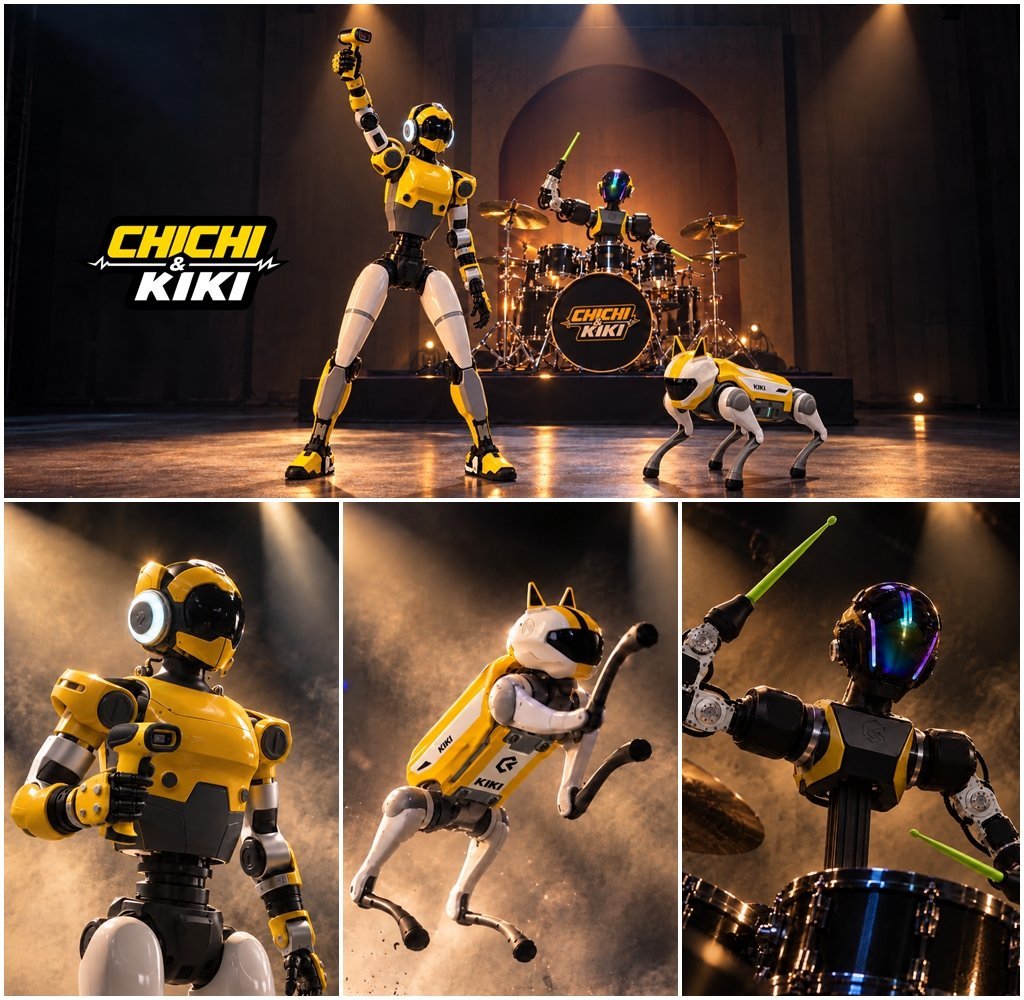
Two robots give the group its name. CHICHI is a humanoid built to move and gesture upright. KIKI has four legs and an entirely different range of movements. A third machine, LOG, has two arms and joins as a guest drummer. They share a stage, but each moves according to its own physical limits.
The debut album is called VERSION 1.0: HELLO, WORLD! — a title familiar to anyone who has written their first line of computer code. Released on October 29, it contains three tracks: “MAGIC.EXE,” “TUTORIAL” and “PATCH NOTES.” KPR describes the record as a story about robots entering the world and learning about humans. The group also released a video for “MAGIC.EXE” through its official online channels.
There is something appealing about the choice of titles. A new version, a tutorial, a set of patch notes: each title suggests a work in progress. Pop fans are used to following an artist’s growth between releases. Here, even the language of software updates is part of the group’s identity. A new dance step might one day be presented as a technical upgrade, too.
Still, it would be a mistake to confuse a story about robots learning with proof that the robots independently wrote the songs. KPR’s announcement describes an extensive human production effort, including music production, movement design and robot control. It does not establish that the machines composed the album autonomously or performed human-style live vocals. The album is real, but describing it as proof that robots can sing or compose on their own would go beyond the evidence.
The hard part is keeping three very different bodies on the beat
Brightbell’s challenge wasn’t simply to make one robot dance. Its engineers had to coordinate three machines whose joints, balance and movement limits differ. CHICHI can strike humanlike poses; KIKI moves on four legs; LOG must align its two arms with a drumming sequence. Sharing the same beat doesn’t mean those bodies can execute the same choreography.
According to KPR, the team developed four pieces of performance software: a studio for designing instrumental motions, another for four-legged choreography, an integrated simulation environment for all three robots, and a controller to start, transition and stop a performance. The company says its engineers repeatedly tested the choreography, in simulation and on real robots, to keep the machines balanced and correctly positioned during performances lasting more than three minutes.
For a conventional dance group, rehearsals solve many of those problems through muscle memory and communication between performers. Robots need a more explicit set of instructions, tested against hardware constraints. A turn that looks effortless on screen can become a problem of weight distribution, timing and collision avoidance on a real floor. That is why the choreography itself may be as interesting to engineers as the resulting music video is to viewers.
The company also intends to make parts of the work reusable. It announced plans to release 50 individual robot motions and approximately nine minutes of performance data covering the three tracks. The proposed materials include recorded or designed source movements, motions adapted to the robots’ joints, and reinforcement-learning-related data and results. KPR says they will be published progressively through the project’s website and GitHub. This is a release plan, not proof that every dataset is already online.
That last detail gives the debut a second audience. A fan might watch because the robots look like musicians. A researcher might watch because the team has solved an interesting movement problem. Few ordinary idol debuts arrive with an announced library of machine-motion data alongside the album.
Robot idols vs virtual idols: how CHICHI & KIKI differ from PLAVE
To understand the difference, it helps to think about what an audience actually sees at a PLAVE concert. PLAVE’s members appear as animated characters, but the voices and performance decisions belong to human artists. In reporting published in May 2025, Reuters described how VLAST uses motion-capture technology to transmit the actions and singing of real performers through digital avatars. A person moves; a digital character represents that movement.
CHICHI & KIKI reverse that relationship. Their public bodies are machines in physical space, moving through motors, joints and control systems. They are not merely screen characters composited onto a scene. A camera can film the robot from the side and capture its position on an actual floor. That physicality introduces a different kind of achievement, along with technical risks that an entirely digital figure does not face.
But the comparison needs one qualification: having a real body does not make a robot an independent musical author. PLAVE’s anonymous performers are human beings whose singing and movements can be attributed to people. In CHICHI & KIKI’s case, the announced robot performance is the visible result of a human-led production and engineering system. The exact vocal-production methods and credits should be checked against official album information before anyone claims the machines generated or sang particular parts.
The distinction that gets lost in the word “AI”
A virtual avatar, a physical robot and a generative AI system aren’t interchangeable. A production might use all three, but seeing a robot onstage doesn’t tell us which tools made its music. Motion capture records or interprets a performer’s movements. Robotics translates commands into movement in the physical world. Generative AI can produce new material from learned patterns. Calling each of them an “AI artist” hides the decisions made by musicians, choreographers, software developers and technicians.
| Question | PLAVE: virtual idol | CHICHI & KIKI: robot group |
|---|---|---|
| What does the audience see? | Animated characters on a screen | Physical robotic bodies |
| How is movement presented? | Human performance translated through motion capture | Engineered and controlled robot motions |
| Who performs the vocals? | Human singers behind the avatars | Specific album vocal credits and methods are not established by the launch announcement |
| Main live-performance challenge | Capture, rendering and communication with the audience | Balance, positioning, joint control and coordination in real space |
| What has been demonstrated? | Music, concerts and a sustained fan relationship | A debut album, video and a developed robotic performance system |
Neither model is automatically more authentic. They simply put the human contribution in different places. For PLAVE, the performers’ human musical identities remain central even when their faces are hidden. With CHICHI & KIKI, the visible performers are technological objects that have been given musical personalities. How fans respond to that distinction remains an open question.
What happens when a concert has to obey physics?
An animated character can jump enormous distances or disappear into the next scene. A physical robot has to stay balanced, preserve its equipment and avoid running into the rest of the set. Those limits can make a robotic show less flexible — but they can also make each successful movement more impressive. Watching a machine turn on a beat is a different experience from watching a perfectly rendered animation do it.
For a venue operator, this raises practical questions that pop coverage rarely asks. How much space does the performance require? How are emergency stops managed? Who maintains the equipment between shows? Can the choreography be adapted to a different floor or a crowded public event? The launch materials describe an integrated controller and testing process, but do not establish a touring schedule, standardized venue requirements or the economics of live deployment. Those details will matter if the project moves beyond controlled demonstrations.
An album is a start. A fanbase is something else.
KPR is not presenting the group as a conventional agency’s idol trainee project. The communications company says it wants to develop robots as a new medium for content and audience interaction. Brightbell handled the technical development and production. The idea began at an internal hackathon in January 2026 and moved into a formal project team in April. This origin makes CHICHI & KIKI as interesting as a business experiment as they are as a music release.
A robot group could eventually be useful for branded events, exhibitions, technology showcases and entertainment installations. The same performance system might be adapted for different music or new movement sets. Yet those are possibilities, not confirmed revenue streams. The launch announcement contains no independently verifiable streaming totals, album-sales figures or audience-retention data. Three released tracks prove there is a product; they do not tell us whether listeners will return for a fourth.
That is where comparisons with established virtual acts need care. PLAVE has had years to develop songs, personalities and a routine of interaction with fans. CHICHI & KIKI is at the beginning. Its audience has yet to show whether it will follow the characters as musicians, as a fascinating engineering project, or simply as something novel to share with friends.
What could change that? A series of performances that differ from one another, more identifiable musical choices, recognizable individual behavior and genuine opportunities for audiences to engage with the group. A robot learning a new dance could be entertaining, but fans also need reasons to care about the next song.
Who should receive the artistic credit?
The arrival of machines onstage makes a familiar question harder to ignore: who created what the audience is enjoying? In an ordinary band, that answer can be divided among singers, musicians, producers and writers. In a robotic performance, engineers and motion designers may contribute just as much to the final experience as the composers. Someone has to turn a drum pattern into motor instructions and turn an idea for choreography into movements a four-legged robot can execute safely.
It is tempting to describe the group as proof that robots can replace artists. The evidence available at debut points somewhere more complicated. A human creative and technical team built a show around robots. Whether future machines can make more of those decisions independently is a separate question, one that needs evidence rather than marketing language.
The KWaveScope view: a new stage, not the end of human pop
The most revealing feature of CHICHI & KIKI may not be the album’s futuristic title or the fact that one member has four legs. It is the attempt to turn a piece of robotics engineering into an act people might follow across songs, videos and performances. A movement library becomes choreography. A robot’s shape becomes a character. A technical update becomes part of the story.
That is also why the distinction from PLAVE matters. Both projects challenge the expectation that an idol must appear as an ordinary human face. But PLAVE puts real human performers behind a digital appearance. CHICHI & KIKI puts engineered machines in front of the camera and asks whether their motions and fictional identities can support a lasting musical project.
On October 29, the answer is not yet a chart position or a sold-out tour. It is three tracks, three robots and a substantial amount of coordinated production work. The next test is whether audiences begin to see more than a clever demonstration.
A robot can be made to dance in time with a song. Becoming an artist in the eyes of an audience is a longer, less programmable process.
Related on KWaveScope
Hidden Faces, Real Voices: What PLAVE’s Music Core Win Reveals About K-Pop
Sources
- KPR — Official CHICHI & KIKI debut announcement, October 29, 2026 (via Newswire)
- Reuters — Reporting on PLAVE’s human performers and motion-capture concerts, May 2025
Editorial note: Album details, robots, software systems and planned data-sharing activities are based on the producers’ announcement and are attributed accordingly. Descriptions of future business models, fan response and artistic implications are analysis, not confirmed outcomes. No claim is made that CHICHI & KIKI independently composed the album or generated vocals. The image credit appears immediately below the official promotional image, without a linked image URL.